Texas Truck Accident Lawyer Statutory Analysis & Legal Guidance Tool

The Texas Truck Accident Lawyer Statutory Analysis Tool is built for Texas commercial vehicle crash victims, attorneys, and legal researchers. Whether a collision occurred on I-35, I-45, I-10, or I-20, the system provides statute based analysis of liability factors, filing deadlines, and evidence preservation requirements. Answers are generated from Texas statutes and federal trucking regulations. Describe your accident scenario below and see how relevant statutes and regulations may apply to your specific situation with direct citations to applicable statutes. Read More

Texas Truck Wreck Legal Assistant Tool

Hello. I am your Texas Truck Accident Legal Assistant. Describe your commercial vehicle collision, and I will analyze relevant Texas statutes and FMCSA regulations.

Loading...

Consulting Texas Statutes...

What Our Texas Truck Wreck Lawyer Tool Does?

This Texas truck accident lawyer legal guidance tool gives you instant, statute-based answers after a commercial truck crash. It analyzes your situation using the:

  • Texas Civil Practice & Remedies Code (CPRC) and Texas Rules of Civil Procedure (TRCP).
  • Texas Transportation Code and permitting rules.
  • Texas Health & Safety Code (medical, hospital liens).
  • FMCSA regulations (49 CFR Parts 382–399).

Whether your accident happened on I-35, I-45, I-10, I-20, or another major Texas freight route, the tool explains fault rules, deadlines, evidence holds, and claim strategy. Built for victims, families, and attorneys, it turns complex Texas truck accident law into clear next steps you can act on immediately.

Chat With Our Legal Assistant tool

Feature 1: Statutory RAG Engine

This legal tool scans thousands of pages of Texas and federal statutes to find the exact rules that support your claim in seconds.

Feature 2: Evidence Preservation

Our truck wreck assistant tool guides you about essential evidence preservation such as ELD, dashcam, and black box holds.

Feature 3: Actionable Next Steps

Our legal assistant tool guides you on how Texas statutes apply to your specific claim? so victims and attorneys can act faster and smarter.

Manual Research vs. Using Texas Truck Accident Lawyer Tool

Winning a commercial vehicle claim in Texas requires more than just knowing the law; it requires applying it faster than the defense can bury the evidence. This comparison shows how our statutory analysis tool applies FMCSA compliance to the Texas Transportation Code and thus transforms a grueling manual process into a decisive legal advantage.

Feature / Benefit Traditional Manual Research Using Texas Truck Wreck Tool
Statutory Mapping Hours spent cross-referencing Texas CPRC and Transportation Codes manually. Instant Statutory RAG Engine maps facts to rules in seconds.
Evidence Preservation Relies on memory or static checklists; high risk of missing ELD/Black Box windows. Proactive alerts for ELD, dashcam, and ECM data holds based on FMCSA 49 CFR.
FMCSA Integration Complex cross-analysis of federal parts (382–399) against state law. Native integration of federal and Texas-specific safety regulations.
Accuracy & Updates Prone to human error or using outdated versions of the TRCP. Real-time analysis using the most current Texas and Federal statutory data.
Output Raw notes that require further synthesis for demand letters. Clear, actionable next steps tailored to the specific crash corridor (I-35, I-10, etc.).

How this Truck Wreck Legal Assistant Tool Generates Answers?

This truck wreck legal tool uses retrieval augmented generation (RAG). Relevant Texas statutes and federal trucking regulations are retrieved first, then analyzed to produce case specific legal guidance. All answers are generated with statute references. Legal rules are cited before conclusions and source databases are periodically reviewed and updated to reflect current Texas statutes and federal carrier regulations.

1

Scans User Query for key facts (e.g., "brakes failed on I-35")

2

Cross-references 49 CFR for violations & Texas Code for liability.

3

Outputs strategy with direct citations (e.g., "Violation of §396.3").

Start Your Free Case Review

Texas Freight Corridors: Indexed Statutory Coverage

Our legal assistant tool is pre-mapped to the specific jurisdictional and safety regulations governing Texas’s busiest commercial routes. Whether the incident occurred on a federal interstate or a state-maintained highway, the tool identifies the relevant Texas Transportation Code and FMCSA sections instantly.

Federal & U.S. Highways

Primary long-distance corridors governed by both Texas Statutes and heavy FMCSA oversight.

  • I-10 (Katy/Baytown): 878.6 miles from El Paso to Louisiana.
  • I-35 (Main Street, Texas): The critical San Antonio-Austin-DFW corridor.
  • I-20 & I-45: Major links between West Texas, Houston, and Dallas.
  • US 83 & US 281: Extensive north-south arteries spanning the entire state.
  • US 59 / I-69: The primary "Southwest Freeway" artery through Houston.

Main State Highways (SH)

Key regional connectors designated by the Texas Transportation Commission.

  • SH 16 & SH 6: Massive north-south routes through Central and North Texas.
  • SH 130 (Pickle Parkway): High-speed I-35 bypass for Austin/San Antonio.
  • SH 99 (Grand Parkway): The essential outer loop of Greater Houston.
  • SH 21 & SH 288: Vital historic and commuter routes to the Gulf Coast.
  • Regional Connectors: Tailored analysis for state-specific permitting rules.

Why Texas Truck Accident Cases Are Different: Key Legal Challenges

Trucking accident claims in Texas are not just car accidents with bigger vehicles. They involve unique legal complexities that require specialized knowledge of both federal and state laws. Here’s why these cases demand a different approach:
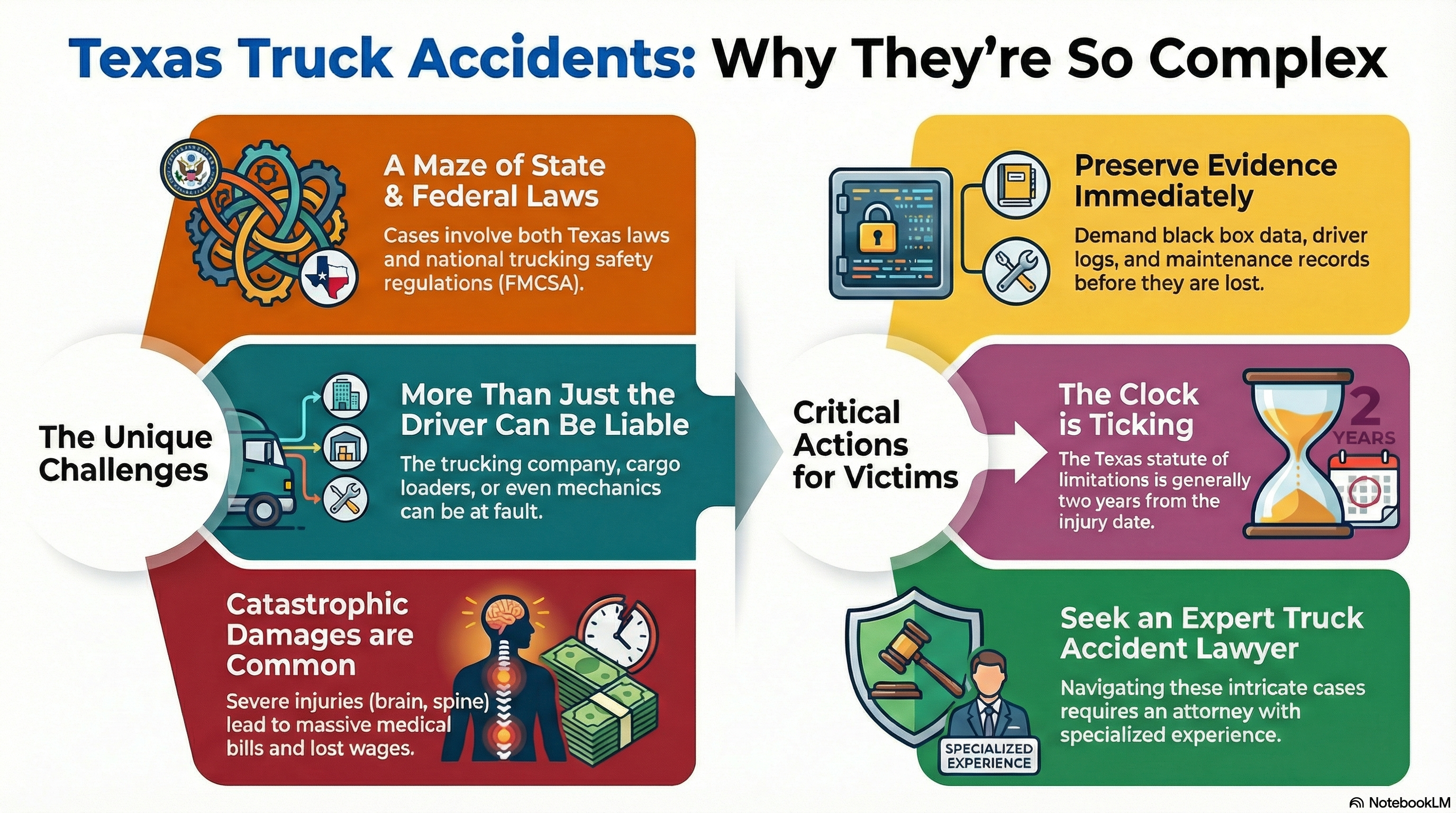
Texas Truck Accident Law Overview

Complex Regulations

Trucking claims involve a "double-layer" of law: Federal FMCSA standards and Texas-specific statutes. Our tool analyzes both simultaneously to find violations.

Multiple Liable Parties

Liability often extends beyond the driver to trucking companies, cargo loaders, and maintenance providers. We help you identify every potential defendant.

Critical Evidence Analysis

Understand the legal weight of spoliation letters, ELD data, black box recordings, and driver logs. Our tool explains how these data points apply to specific Texas rules.

Catastrophic Damages

From TBI to wrongful death, this truck wreck tool provides the statutory context for maximizing recovery on medical bills, lost wages, and long-term suffering.

Strict Deadlines

The Texas statute of limitations is generally two years , but vital electronic evidence can be legally "purged" in weeks if you don't act.

Technical Advantage

Navigating these cases requires expert-level insight. Our tool provides the foundational research needed to work effectively with specialized legal counsel.

Texas Truck Accident Law: Federal vs. State Statutory Landscape

Understanding the interplay between federal FMCSA regulations and Texas state laws is crucial for building a strong truck accident case. This section breaks down the key statutory frameworks that govern commercial vehicle safety and liability in Texas, highlighting how our tool navigates these complex legal waters to provide you with actionable insights.

Federal (FMCSA) Rules

The FMCSA sets the gold standard for safety across the U.S. Our tool scans these 49 CFR parts to find violations in:

  • Hours of Service (HOS): Preventing driver fatigue.
  • Drug & Alcohol Testing: Strict protocols for controlled substances.
  • Vehicle Maintenance: Ensuring "road-ready" safety standards.
  • CDL Standards: Licensing and driver qualification rules.
  • Cargo Securement: Rules to prevent shifting or falling freight.

The Texas Framework

Texas often aligns with federal rules but adds its own layer of enforcement through the TxDPS and TxDOT.

Texas Transportation Code Chapter 644

The primary framework for state-level enforcement of commercial vehicle safety standards.

Our tool identifies Texas-specific nuances such as:

  • Intrastate-only carrier exemptions.
  • Texas-specific permitting and weight rules.
  • Administrative Code (TAC) alignment with FMCSA.

Identifying whether a truck accident involves an interstate or intrastate carrier, and thus which specific set of regulations applies, is a crucial step in building a strong case. A violation of either federal or Texas state trucking regulations can constitute a hours-of-service, maintenance, and inspection violations (FMCSA + Texas) and serve as powerful evidence of negligence in a personal injury claim.

Defining Duty & Breach: The Anatomy of Negligence

In Texas personal injury law, specifically concerning truck accidents, the concepts of "duty" and "breach" are foundational to establishing negligence. Every individual and entity involved in the operation of a commercial truck owes a duty of care to others on the road. This duty essentially means acting as a reasonably prudent person or entity would under similar circumstances to prevent foreseeable harm. For a truck driver, the duty of care includes, but is not limited to:

The Driver's Duty

  • Operating the vehicle safely, adhering to all traffic laws and posted speed limits.
  • Maintaining a proper lookout for other vehicles, pedestrians, and road hazards.
  • Avoiding distracted driving, fatigued driving, or driving under the influence of drugs or alcohol.
  • Ensuring their commercial vehicle is in safe operating condition before and during a trip.
  • Complying with all federal and state hours-of-service, maintenance, and inspection violations (FMCSA + Texas) regulations.

The Trucking Company's Duty

  • Properly hiring, training, and supervising their drivers.
  • Regularly inspecting and maintaining their fleet of vehicles.
  • Ensuring drivers comply with all HOS regulations and do not operate while fatigued.
  • Not pressuring drivers to violate safety regulations to meet delivery deadlines.
  • Maintaining adequate insurance coverage.

What is a "Breach of Duty"?

A breach occurs when these standards aren't met like a company skipping a brake inspection or a driver ignoring speed signs. Our tool connects these breaches to specific statutes, proving the link between action and injury. Establishing this breach is a critical step in linking the defendant's actions (or inactions) to the accident and the resulting injuries, forming the basis for a negligence claim. Understanding who can be liable: driver, carrier, broker, shipper, manufacturer, maintenance is paramount in these complex cases.

Who Can Be Liable in a Texas Truck Accident?

A common mistake in truck accident claims is only looking at the driver. In reality, a single wreck often involves a chain of liability. Our tool analyzes your query to help you determine which of these entities breached their duty under Texas and Federal law.

The Truck Driver

Liable for operational errors like speeding, distracted driving, or violating Hours of Service (HOS) limits.

The Trucking Carrier

Often the primary defendant under Respondeat Superior or for negligent hiring, training, and supervision.

Shippers & Loaders

Responsible if improper cargo securement or overloading caused the truck to tip or lose its load on a Texas highway.

Logistics Brokers

May be liable for "negligent selection" if they hired a carrier with a known history of FMCSA safety violations.

Vehicle Manufacturers

Liable if a mechanical defect,like a faulty brake system or tire blowout, directly caused the collision.

Maintenance Teams

Third-party mechanics can be held responsible for failing to perform required inspections or making negligent repairs.

Key Evidence Types in Texas Truck Accident Cases

The success of a Texas truck accident claim hinges on the quality and comprehensiveness of the evidence collected. Unlike typical car accidents, commercial truck crashes generate a unique array of evidence that must be secured quickly before it is lost or destroyed. Common causes and evidence (logs, black boxes/ECMs, maintenance, hours-of-service) are often intertwined. Key types of evidence include:

Black Box (ECM/EDR)

Modern trucks record critical data like speed, braking, and steering. Immediate spoliation letters are required to preserve this data. Specialized skills are needed to read a truck’s black box data.

ELD Records

Crucial for proving fatigue. In 2026, new mandates require continuous GPS tracking making it harder for carriers to hide HOS violations.

Driver Qualification

Look at 49 CFR §391 to help you see if a driver was unqualified, medically unfit, or failed a drug test.

Maintenance Logs

Systemic neglect is a breach of Part 396. Service logs can prove if a mechanical failure was caused by a trucking company’s failure to perform required repairs.

Cargo Manifests

Overloading or poor securement violates TX Transp. Code Ch 725. Check for "unsecured load" liability.

Official Reports

From TxDOT crash reports to witness accounts, our tool provides the context needed to verify law enforcement findings.

Video Evidence

Dashcam and surveillance footage can be game-changers. Our tool helps you understand how to use video evidence effectively in a claim.

Police Accident Report

The official law enforcement findings. Victims must know how to get a crash report in Texas.

Witness Statements

Eyewitness accounts can corroborate or challenge official reports. Our tool helps you understand how to collect and use these statements effectively.

Investigation Checklist: Evidence Recovery

Commercial Motor Vehicle (CMV) Litigation — Texas

Trucking companies often have document retention policies that allow for the destruction of digital logs after 6 months. Our tool suggests issuing immediate Spoliation Letters to freeze this evidence.

THE "DIGITAL DNA"

  • ELD Logs: Raw data from the Electronic Logging Device (49 CFR § 395).
  • ECM Data: Speed, braking, and steering inputs from the "Black Box."
  • Telematics: Real-time carrier monitoring of "hard braking" events.
  • On-Board Video: Dashcam footage from both the truck and surrounding vehicles.

DRIVER & CARRIER FILES

  • DQ File: Driver Qualification records and road test results (49 CFR § 391).
  • Toxicology: Mandatory post-crash drug/alcohol test results.
  • Maintenance Logs: Last 12 months of repair and inspection (49 CFR § 396).
  • Training Manuals: Evidence of carrier safety culture and hiring standards.

SCENE & LOCAL RECORDS

  • Texas CR-3: Official Crash Report from APD, TCSO, or DPS.
  • EMS Trip Report: Records from Austin-Travis County EMS (Health & Safety Code § 773).
  • TXDOT Video: Traffic camera footage from I-35 or US-183 corridors.
  • Witness Statements: Affidavits from bystanders and first responders.

The Demand Letter: Your Blueprint for Settlement

In Texas truck wreck litigation, the Demand Letter is a formal legal document that synthesizes evidence and statutes into a compelling argument for maximum compensation. Our legal tool helps in:

Part 1: The Liability Argument

This tool cite specific statutory violations to prove Negligence Per Se:

  • Federal Violations: Our tool cite 49 CFR Part 395 for Hours of Service (fatigue) or Part 396 for brake failure.
  • State Violations: Our tool cite the Texas Transportation Code for speeding on I-35 or improper lane changes on the MoPac.
  • Evidence Link: This tool tries to integrate ELD data and Black Box (ECM) reports as "Exhibit A."

Part 2: The Damage Valuation

Under TCPRC Chapter 41, itemize every loss to ensure no money is left on the table:

  • Economic Losses: Helps in full medical billing (under the "paid vs. incurred" rule) and verified lost wages.
  • Medical Severity: Use Texas Health & Safety Code § 773 to define the traumatic nature of your injury.
  • Human Impact: Narratives on pain, suffering, and "Loss of Consortium" for family members.

Understanding the "Bifurcation Rule"

Under Texas Civil Practice & Remedies Code § 72.052, trucking companies are granted a specific legal protection that changes how your case is presented to a jury.

The Bifurcated Trial: Phase 1 vs. Phase 2

Commonly referred to as the HB 19 law, this statute requires a trial to be split into two distinct parts if the trucking company requests it. This is a tactic used to shield corporations from their own negligent history during the initial phase of a lawsuit.

Phase 1

The Driver's Negligence

In this stage, the jury only hears about the crash itself. They decide:

  • Was the truck driver negligent?
  • Were you partially at fault (TCPRC § 33)?
  • What are your Compensatory Damages (medical bills, pain and suffering)?

Note: Evidence of the company's poor hiring history is usually EXCLUDED here.

Phase 2

The Carrier's Direct Liability

Only if the driver is found negligent in Phase 1 do we move to Phase 2. Now the jury hears about:

  • Negligent Hiring: Did they hire a driver with multiple DUIs?
  • Negligent Training: Did they fail to teach FMCSA safety protocols?
  • Exemplary Damages: Punishing the company for gross negligence under TCPRC § 41.

Why This Rule Favors Trucking Companies

The Bifurcation Rule was designed to prevent a jury from becoming "angry" at a company’s corporate history before deciding the facts of the specific accident on an Austin highway.

Glossary: Legal & Technical Trucking Terms

To help you understand the technical discussions during your claim, here is a breakdown of the terminology used in Texas trucking litigation:

Spoliation of Evidence
The legal term for the destruction, alteration, or failure to preserve evidence. In Texas, if a trucking company deletes logs after receiving a notice, a judge may provide a "spoliation instruction," telling the jury to assume the evidence was bad for the company.
Electronic Control Module (ECM) / "Black Box"
An onboard computer that records technical data such as engine speed, brake application, and GPS location at the exact moment of an impact on highways like I-35.
Electronic Logging Device (ELD)
Technology used to automatically record a driver’s Hours of Service (HOS). This is the primary evidence used to prove driver fatigue under 49 CFR Part 395.
Vicarious Liability (Respondeat Superior)
A legal doctrine holding the employer (trucking company) responsible for the negligent acts of the driver, provided the driver was acting within the scope of their employment at the time of the crash.
Telematics
A system that transmits real-time data about vehicle behavior (acceleration, hard braking, cornering) to the motor carrier’s home office. We subpoena this data to show a pattern of reckless driving.
Negligence Per Se
A legal theory where a defendant is considered negligent because they violated a specific statute (like a Texas Transportation Code speed limit or an FMCSA safety rule) designed to prevent the type of harm that occurred.